


Act fast when stroke strikes
Baptist Desoto’s stroke team delivers expert care
May is American Stroke Month, and Baptist Memorial Health Care’s team of experts wants you to know that strokes can occur without warning. And when they do, time matters most.
Stroke is a medical emergency and a leading cause of death and long-term disability among adults in the U.S. North Mississippi is located within the Stroke Belt, a geographic region where stroke incidence and mortality rates are among the country’s highest.
It’s also home to Baptist Memorial Hospital-Desoto in Southaven, which began offering expanded, in-person stroke services in December 2025. Baptist Desoto’s stroke program is designed to deliver fast, coordinated care through a multidisciplinary team of experts, including neurologists, emergency physicians, nurses, radiology and lab specialists, pharmacists and rehabilitation therapists.
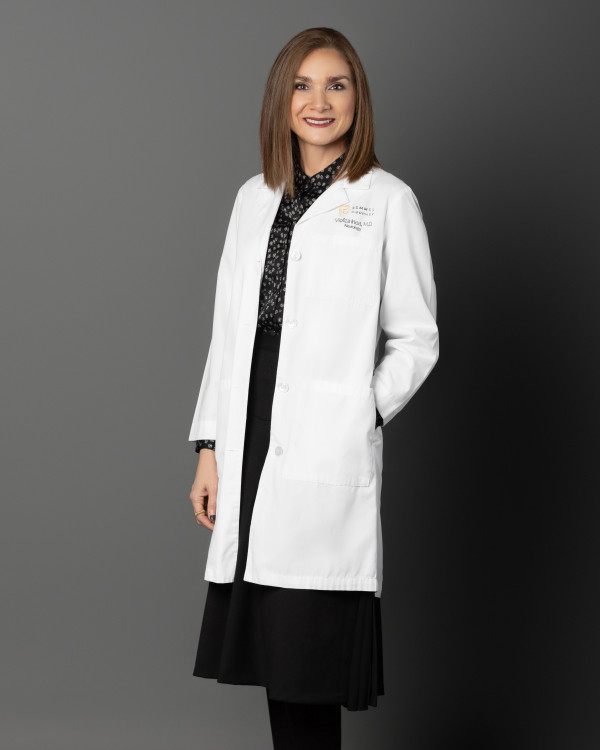
When you call 911, EMS alerts the hospital so the stroke team is ready when you arrive, and that coordination helps us begin treatment as quickly as possible.

Dr. Violiza Inoa is also medical director of stroke and neurointervention at Baptist Desoto, which has earned The Joint Commission’s Gold Seal of Approval for Primary Stroke Center Certification for its commitment to high-quality stroke care.
Who’s at risk?
Risk factors for stroke mirror those of cardiovascular disease and include high blood pressure, high cholesterol, diabetes, obesity, smoking, substance abuse, physical inactivity and diets high in sodium and saturated fats.
Limited access to health care can increase risk, particularly when conditions, such as hypertension and diabetes, are not well controlled.
Although stroke is most common in adults age 65 and older, it can occur at any age. Inoa said 10-15% of strokes occur in adults younger than 50.
Pregnant women also face increased risk, especially in the third trimester and postpartum period when blood clotting disorders may occur.
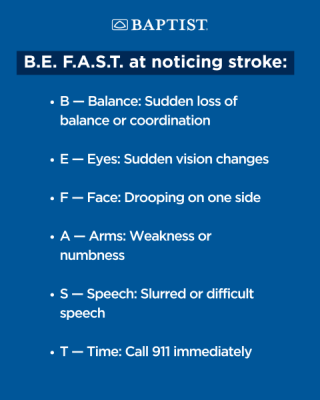
Know the signs
It’s critical to know the signs of stroke. Baptist recommends the B.E.F.A.S.T. acronym as a guide to recognizing stroke symptoms.
Other symptoms of stroke can include sudden severe headache, confusion or vertigo.
“Stroke is a sudden-onset condition, and a person can be completely normal one moment, then suddenly lose the ability to speak, see or move,” Inoa said. “And for every minute that passes, we lose neurons and function.”
Fast treatment equals better outcomes
The good news is rapid treatment can significantly improve outcomes for stroke patients.
Studies show that patients who receive treatment within four and a half hours of symptom onset are more likely to survive and less likely to experience long-term disability. But when it comes to treatment, the sooner the better.
Treatment depends on the type of stroke, but for many patients, medications known as thrombolytics can restore blood flow to the brain.
These medications work by breaking up clots and are associated with better outcomes.
In some cases, particularly when a large blood vessel is blocked, doctors may perform a mechanical thrombectomy, a minimally invasive procedure to remove the clot.
The most common type of stroke is ischemic stroke, which occurs when a clot blocks blood flow to the brain. But about 15% to 20% of strokes are hemorrhagic, caused by bleeding in the brain due to a ruptured blood vessel.
That is typically a more severe type of stroke with higher mortality, and it’s often associated with uncontrolled high blood pressure.
Prompt treatment for hemorrhagic stroke can improve outcomes by stabilizing blood pressure and preventing further damage.
If you think someone may be having a stroke, it’s imperative that you call 911 immediately.
Acting quickly can save brain function, reduce disability and save lives.
Baptist Memorial Hospital-DeSoto Stroke Services
Baptist DeSoto has been awarded The Joint Commission’s Gold Seal of Approval for Primary Stroke Center Certification, a symbol of quality that reflects commitment to providing safe and quality patient care. Baptist DeSoto’s stroke team includes a neurologist and several departments working together to quickly assess signs of a potential stroke and begin administering care. The hospital was recognized by U.S. News & World Report as a high-performing hospital in six specialties for 2025–2026, the American Heart Association for cardiac and stroke care and the American College of Cardiology as a HeartCARE Center National Distinction of Excellence in 2025.