Baptist is first in region to offer new mammogram technology
Expanded facility will serve 8,000 more women
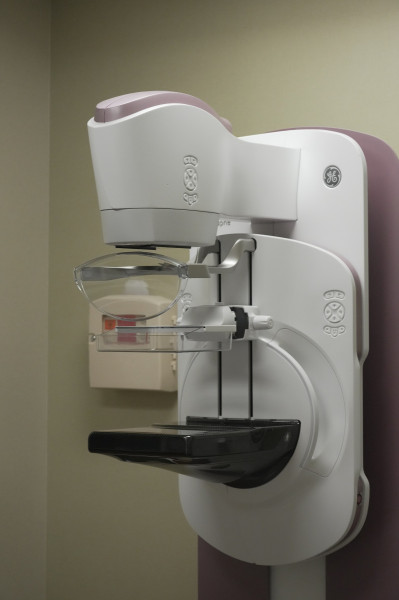
Baptist Women’s Health Center is the first center in the Mid-South to offer contrast-enhanced mammograms, an innovative approach to streamlining the mammogram process for high-risk patients. The new mammograms are offered at the recently expanded facility on Humphreys, which can now serve an additional 8,000 patients a year.
Contrast-enhanced mammography (CEM) uses groundbreaking technology for early breast cancer detection, producing more precise images compared to standard 3D mammograms. This is especially helpful for women with dense breast tissue, which includes about half of all women.
Dense breast tissue can make it more difficult to detect abnormalities. Even when tumors are detected, the full extent of the disease may not be clearly visible with a standard mammogram. Many women with dense breast tissue may require additional imaging after their initial mammogram, such as ultrasounds and MRIs. With the new contrast-enhanced mammogram, the extra steps may be eliminated.
An iodine-based dye is injected through an IV before taking mammogram images. The dye travels to areas of increased blood flow. Because tumors require a blood supply to grow, the surrounding blood vessels collect the dye, making it easier to detect tumors. Special software minimizes the dense tissue in the background, so areas of concern are more visible.
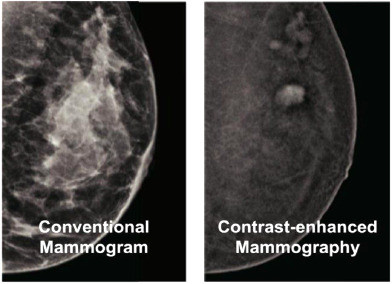
“Contrast-enhanced mammography helps level the field for detecting breast cancer early in all women,” said Dr. Lynn Gayden, medical director of Baptist Women’s Health Center. “This new technology may decrease the number of breast biopsies and follow-up testing required, as well as provide more comfort and reassurance for women with dense breast tissue.”
Contrast-enhanced mammograms have several additional benefits. The process is faster and less expensive than an MRI, and it’s generally more comfortable for women, particularly those with claustrophobia who may be anxious during an MRI. The CEM may also provide patients with a definitive answer on the day of their visit compared to possibly waiting days or weeks for MRI results.
A contrast-enhanced mammogram does not take much longer than a standard 3D mammogram. Once an IV has been inserted, it takes two minutes for the contrast dye to be injected. The imaging takes place within seven minutes of the contrast entering the body.
“We’re excited to offer the latest technology in early breast cancer detection,” said Jennifer Martinez, administrative director of Baptist Women’s Health Center. “We traveled to Boca Raton to learn about the contrast-enhanced mammogram and knew this would benefit so many women in the Mid-South. We’re proud to be the first to offer these advanced mammograms to our patients.”
Most women should begin receiving annual mammograms at age 40. Women with a family history of breast cancer should begin earlier. If you have a family history, talk to your health care provider about your risks.
A physician referral is required for the contrast-enhanced mammogram, based on the patient’s medical and family history. The CEM is part of a diagnostic mammogram workup if an irregularity is found on a regular mammogram.
WHAT DOES IT MEAN TO HAVE DENSE BREASTS?
Breasts contain several types of tissue: glandular, fibrous connective and fatty breast tissue. A woman’s breast density is based on how much of each tissue type is present in her breasts. Dense breast tissue has higher amounts of glandular and fibrous connective tissue, but lower amounts of fatty breast tissue.
Dense tissue can make it more difficult to see abnormal breast changes, such as tumors, because the tissue itself and the abnormality both appear as white areas on a mammogram. Fatty tissue appears as a dark area, so the white area of a tumor is more visible in contrast to the tissue.
How can I find out if my breast tissue is dense?
Your personal breast tissue density can’t be determined through a self-exam or from your doctor’s manual breast exam. Only a radiologist can determine breast density based on your mammogram images.
I’ve been told my breast tissue is dense. Is this common?
Yes, approximately 50% of women have dense breast tissue. It’s not something that needs to alarm you, but it does mean you may require additional screening techniques to get the best views of your breasts. Dense tissue can make it more difficult to detect abnormalities, so your doctor may want you to have follow-up procedures, such as ultrasounds, MRIs or even a contrast-enhanced mammogram as mentioned above.
Are there different levels of breast density?
Doctors use the Breast Imaging Reporting and Data System (BI-RADS) to classify breast density. This system was developed by the American College of Radiology and classifies breast density into four categories:
A. Entirely fatty breast tissue: Almost all of the tissue is fatty. Because this tissue is not dense, it is easier to see tumors or other abnormalities on a mammogram. This is found in about 10% of women and is more common in older women.
B. Scattered fibroglandular breast tissue: The breasts contain mostly fatty tissue with some areas of dense glandular and fibrous connective tissue. About 40% of women have this type of tissue.
C. Heterogeneously dense breast tissue: This breast tissue contains large areas of dense glandular and fibrous connective tissue, with some areas of fatty tissue. It is difficult to detect changes and abnormalities in dense areas. This is found in about 40% of women.
D. Extremely dense breast tissue: Almost all tissue is dense glandular and fibrous connective tissue, with little to no fatty tissue. Women with extremely dense breast tissue have a higher risk of cancer than those with little to no dense tissue. This occurs in about 10% of women.
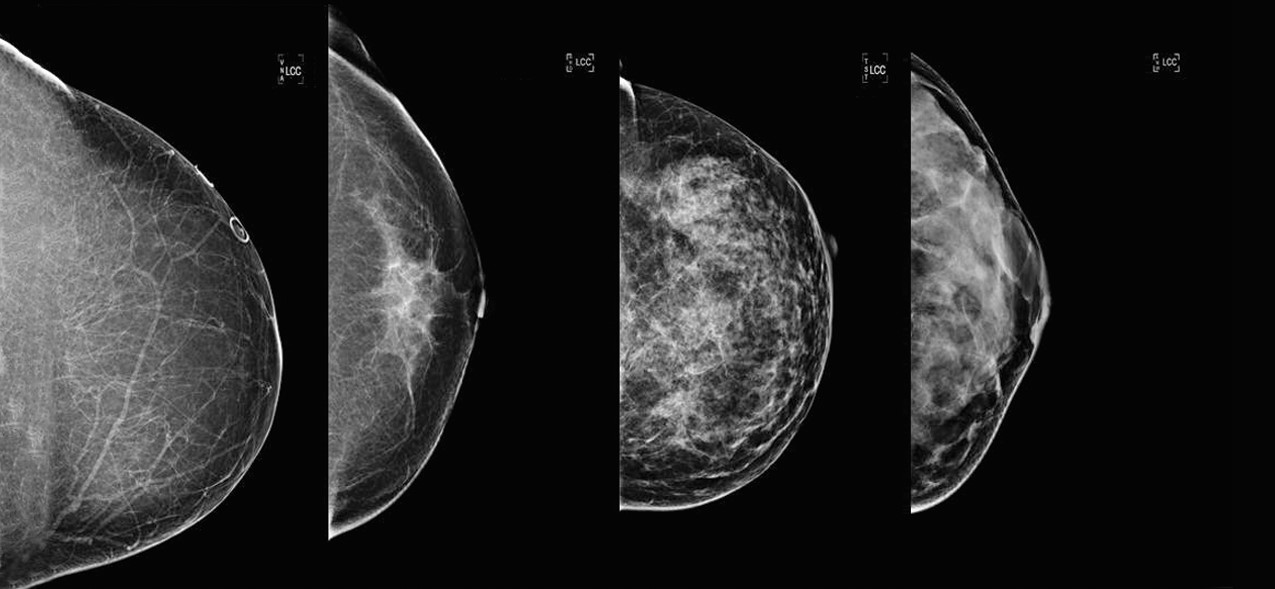
The four categories of breast density, in order from A to D.
Mammogram reports contain information about your breast density. If your report says you have dense breasts, your tissue falls into the category of either heterogeneously dense breast tissue or extremely dense breast tissue.
For more information about breast cancer services at Baptist Women’s Health Center, click here.